Rolfing in Boulder

Scar Tissue and Rolfing® Structural Integration

Saturday, Oct. 30th 2010

Another great reason to see a Rolfer™-after many surgeries, there will be residual scarring. These scars become a veritable drag in the fascial network of your whole body: appendix scars reach down and adhere to many deeper structures; scarring around knee surgeries can later exert a drag that pulls your back, causing stiffness and pain, and more.

Curiously, one of the problems with scar tissue, in relation to neighboring skin, muscle and fascia is that it is too uniform. Normal tissue has a glorious chaos to it, one that is incredibly flexible and adaptable, yet weaves here, there, and everywhere, where scarring tends to be too linear in fiber direction-nature’s way of buttressing the area. As with other things, like inflammation, that can occur when nature is allowed to just take its course, this is too much of a good thing. More fluidity is what is needed, in this case. By probing, oscillating, rocking, cross-fiber shearing and stretching, a Rolfer is also soothing, hydrating, and re-educating the scarred and stiffened area. We seek to bring it back to the normal chaos of human structure, to allow for the normal functional adaptability, all-dimensional flex/extension and support required in our bodies.

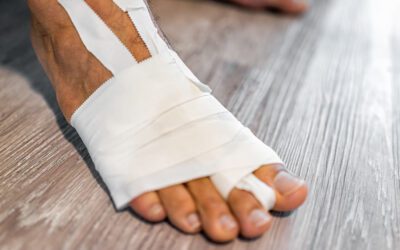
I will be putting my money on this approach myself soon. I have to get foot surgery December of this year, and am setting up appointments with Rolfers to work and re-work the mass of scar tissue this will create. While the thought of getting fairly radical foot surgery is terrifying for an old dancer ( and yes, it is because I am an old dancer that I need to get it done), the thought of having the support from these gifted bodyworkers really helps me, emotionally.

Posted by rob | in Dance, Rolfing | No Comments »

Re-conceive Your Feet!

Saturday, Oct. 23rd 2010

How do we express ourselves through our feet? We think of dancers being very connected to their feet-to the expression of energy and rhythm, and shape, spatial positioning. But all who walk upright live from the ground up, in how we relate to the earth, and how we support our spines, heads, and dreams.

Feet are not blocks of wood. They are lithe instruments of perception and action. Opening them up to a greater range of motion, responsiveness allows the whole person to feel as if they are ‘growing up out of the ground’, finding better balance, and helping us to feel more emotionally centered as well. For dancers, I would call on you to experiment with openings all through the foot; not just the ability to point or plie. How easily can you stand? Can you release through the heel and ankle? Can you allow the gentle spiral of balanced rotations, of balanced supination, in the standing part of gait, to pronation in the push off phase?

The hardest thing about this for many dancers is the act of venturing outside of the limits of the training that they have received, from ballet and many forms of modern dance and jazz. If nature had intended us to have feet like pointe shoes, we would be proportioned like elephants, who are so large in relation to their feet that they are essentially always “sur les pointes”-walking on an extremely small surface area. How many ballerinas can claim the softness of gait and agility of an elephant, really?

Bodies are a constant work in progress, for better or worse. They respond to how we move, in daily life, class, at the gym or whatever. One of the theories about bunion development, for example, is that the stress is going into that part of the foot because of an overuse of the big toe/first metatarsal joint, and usually in a laterally rotated lower leg. Worse, instead of a bunion,an arthritis can develop in this joint, possibly leading to a total fusion and immobility there.

What I wonder is; what important joints and muscles above this joint are being underused, to create overuse in this area? By opening movement through the heel and ankle, we can hopefully head off this kind of dysfunction and pain. I teach my clients how to work with balls to help with this, and movement coaching in gait. A positive byproduct of this work is increased sureness in standing and walking, and more ease and confidence. I think of a sense of joy that rises up from below, naturally, like the Asian concept of a ‘bubbling spring’ coming up from the ground and through the feet. What a great idea!

Posted by rob | in Dance, Relaxation | 1 Comment »

How Rolfing® Works, for Me-Part 3

Friday, Oct. 15th 2010

How have I made the transition from dancer to healer? I am finding more and more that I utilize the skills and sensitivity developed over decades of work as a professional performing artist. Dance is not just dexterity and strength combined-it can hone our perceptions and how to act on them. Good dancers develop not just a sense of movement mechanics, line, musicality or spatial sense; they also employ a general knowledge of aesthetics, art history, situational intelligence and much more. We train ourselves to explore general principles in movement, in modern dance for instance, while honing them into very specific techniques and maneuvers. We learn how to manage the shapes that we are trying achieve, in relation to others, and in relation to the overall stage image that the choreographer is creating-or at least our understanding of it! All of this is a way to enhance perception of self and other in space, time and gravity.


One of the things you will often hear a Rolfer™ ask you or talk about in a structural integration (SI) session is the way one part of the body feels in relation to another part. This is partly because we are trained to perceive the body in terms of relationships-how does the thorax relate to the pelvis, how does the pelvis relate to this or that leg, and to the spine, and on and on. Another part of this is the notion of “end feel”, where we try to sense how the distant part is in relation to the point of contact. “How do you feel in the lower back on the left side” we’ll ask, for example, while sensing a fixation in the atlanto-occipital joint-this is where the head meets the top of the spine. It is hard, exactly, to quantify end feel, and I believe that different Rolfers go about this differently. I personally utilize all of my senses for this, including, but not limited to: rhythm, sub-cortical movement sense, aesthetic/visual sense, spatial brain, sense of weight and balance, analytical brain, and tactile sense.


In general, though, this involves the ability to touch in one place and “feel through” the structure to another area. You can liken this to being able to feel the position of a ball, ten feet away, when you contact it with a ten-foot pole. A lot of subtleties can come through this touch, regarding fluid pressure, springiness, stiffness and the like. Rolfing® SI, then, demands a lot of sensitivity, along with sufficient knowledge to distinguish different structures and understand the roles they can play in normal, or abnormal function. There is one sort of end feel when weight, length, movement, breath, heartbeat, or cranial-sacral rhythms are able to move freely through, and another when they cannot. Identifying where this flow is interrupted is part of what we try to do using end feel. This is very helpful for knowing where to work to get the maximum benefit for clients. It is often not ‘where it hurts’. It is often in a place that relieves strain on painful areas.


A little more ‘about me’ here: working in this way demands a lot of sensitivity-thank God! Finally I have another excellent place to make use of these kinds of perceptions! They worked for me, before, as a professional dancer, choreographer and teacher, and come in very handy as a Rolfer. I liken it, too, to the ability to sense where someone a dancing partner is in space, how they are moving, where they have their weight, what kind of attack or sustain-pattern they are using-and on and on! I spent over twenty-six years performing dancing professionally, and developing this ability to respond to the movements of another dancer. For me now, Rolfing is very much a unique dance with each client.


Feeling through, as we work, and trying to understand what layer (or layers) is adhered to what other layer(s) is akin to the princess trying to figure out how many mattresses down the pea is. Ok, hopefully you have heard the story of the princess and the pea! I will mention here that there at least seven different layers of fascia in the neck alone. Knowing which one is problematic can be a key for how to work the entire body. It is a lot more than ‘rub where it hurts’ folks!


There are many skill sets that a good Rolfer needs to be able to draw from. End feel, sensitivity to layers, functional and anatomical knowledge are necessary to couple with knowledge of techniques to release fixations, in the appropriate sequence, and then integrate. But then, the notion of “the proper sequence” and “then integrate” can be the subjects of future posts!


Posted by rob | in Rolfing | No Comments »

Street Dance: Earth and Sky, Kelly and Astaire

Thursday, Oct. 14th 2010

Comments on this popular video:http://www.facebook.com/video/video.php?v=1664492411895&ref=mfI decided to take a look at this wearing my dance and Rolfer™ hats. One thing a Rolfer looks for in a client is their movement initiation preferences for using ground and spatial orientation. We all do both all the time, of course, but we will have a tendency for one over the other. This pattern is termed here ‘G’ for a grounded, weighted, push preference, and G’ for a spatial, lighter, reach preference. The terms also indicate ‘functional centers of gravity’ for an individual: a G individual’s functional center of gravity lower, nearer the area below the belly button and downwards, and a natural ‘down’ focus in the eyes and in coordination; a G’ individual naturally carries their functional gravity center higher, in the chest area, with a natural ‘up, out and around’ attention. In terms of iconic dancers, this is often simplified into G’=Fred Astaire, and G=Gene Kelly.Both of these are important and valuable functional patterns. They are important to recognize because often the one that is dominant in an individual is part of the problem with postural or muscular pain and dysfunction. Because it is “familiar” to the individual, it also needs to be part of the solution, on the way to later opening up to the other preference to round out or relax the individual into better alignment in movement.So, the question is, are these dancers more G or G’? My impression is more G’, but within a very “grounded” movement context (?) . There is some strong use of ground in the more gymnastic parts at the end, so it would submit to a more detailed look. Looking at the beginning, the dancers lilt and skate over the ground, like ice skaters. Regarding the ’street vs art’, the partnering is clearly ‘modern dance’ in look and feel. These guys have seen the inside of a dance studio, regardless of what medium they are now working in, and bring that background to this video-at least in the opening of the video.So, more Astaire than Kelly; more sky than earth, at the start. They glide and float around and over imaginary spaces and fulcra. Balletic twirls with arms raised overhead, but the shoulders are still tight into the neck-this is ‘imitation’ and playing around, more than use of a balletic movement-base, a bit like Fred Astaire incorporating turns in his routines that look like ballet, but clearly were not the product of years of training in that style. One lad does a wonderful turn on the tip of his sneaker that is extraordinarily rooted, for me, in a way that most ballerinas would die to be able to be. The shoes, and his native strength, allow this sense of ‘ground’ on point. Again, many contemporary ballerinas would love to achieve that, but don’t.The same fellow takes lovingly, perhaps reverently to the ground for a ‘breaking’ style ground spin, as much paying homage to the style as anything, showing his fluency earth/sky. The striped short gentleman than goes so far as bend over backwards to ‘one-up’ the previous, using his head as a landing point and support. This looks very ‘ground’-mainly because the ability to yield into the movement is what saves him from injury-but the jarring look of the landing shows less adaptability than he, and we, might like. Orange raincoat man shows explosiveness out of the ground, like a gymnast, more fully confident in his yield to pushing sequence, which is a hallmark of effective G orientation, to me. White T-shirt shows the success in an ‘up-based’ strategy for an equally athletic flip in the air, his preparation for jumps coming by clearly establishing length and spatial pulls, like a ballet dancer might, before a tours en l’air. All-black outfit shows again his fluency between up and down orientations, yet is subtly more G than G’, for me, not just in his choreographic choices of movement, but in his sensitively weighted efforting, even in turns and ’skating’ movements.The gestural bit at the end shows the essentially improvisational collaborative and playful nature of the whole thing. The gestures are like a sign language with the hands, chest and torso, very G’ in their way of relating to the group and their common space.

Posted by rob | in Dance, Relaxation, Rolfing | 3 Comments »

How Rolfing® structural integration works, 2

Sunday, Oct. 10th 2010

Session One in the ten-session series sequence helps free all structures around the ribs, to help free up the breath, and to ease the tilt in the pelvis. Some unexpected benefits may come already from that first session, though. Freeing the shoulder girdle from the ribs can help to relieve tension at the top of the thorax, called the thoracic outlet ( see wikipedia here) . When this is impinged, it changes the pressure down through the whole thorax. Getting more openness here can re-balance this pressure. Work between the abdominal fascial layers can reach around and free the back, but also can open and energize the psoas muscles. This “session one” work can help to achieve the sensation of effortless lift through the whole body that is a hallmark of Rolfing® structural integration. This can also, in the case of a recent client, help to ease the pressure down into a prolapsed uterus, giving her some long-sought relief.

The point is that the encouragement of lift can help in many ways that you don’t anticipate. Following the natural principles in the body makes it more functional, at the external, full-body movement level, and also at the level of the organs and viscera. This can also ease long-standing pain and discomfort in delicate regions that don’t submit to “massage”. To get integration of this work so that it holds will take more work into the whole body, to anchor better support, fluidity, ability to adapt, and ability to reach or yield through all directions. The work is never perfect..but it is pretty darn good!

Posted by rob | in Rolfing | No Comments »